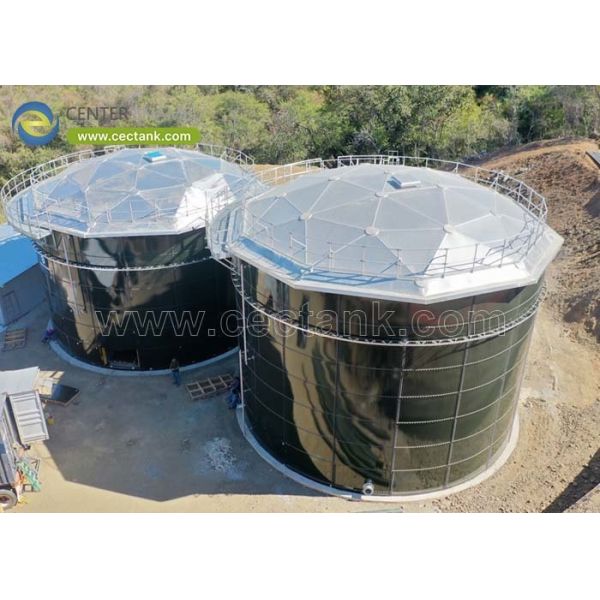
GFS Seawater Desalination Tanks: Advanced, Corrosion-Resistant
Engineering by Center Enamel
With global water scarcity on the rise, seawater desalination is
becoming an essential solution for meeting municipal, industrial,
and agricultural water needs. At the heart of any successful
desalination infrastructure lies effective, safe, and durable water
storage—encompassing raw seawater buffers, intermediary process
tanks, and post-treatment potable or industrial water tanks.
Seawater presents extreme challenges due to high salinity and
corrosive chemistry, demanding the most advanced storage
engineering. Center Enamel’s Glass-Fused-to-Steel (GFS) seawater
desalination tanks provide a future-proof answer, blending
mechanical robust steel with the chemical inertness of glass to
ensure reliable, long-lasting performance.
As a leading storage tank manufacturer worldwide. Center Enamel can
provide Glass Lined Steel(GLS) tanks, fusion bonded epoxy tanks,
stainless steel tanks, galvanized steel tanks, welded steel tanks
and aluminum geodesic dome roofs, Wastewater and Biogas Project
Equipments for global customers.
| Configuration of Customized Storage Tanks |
| Storage tanks | Volume | Roofs | Application | Design Requirements |
GLS Tanks SS Tanks Fusion Bonded Epoxy Tanks Galvanized Steel Tanks Welded Steel Tanks | <1000m³ 1000-10000m³ 10000-20000m³ 20000-25000m³ >25000m³ | ADR Roof GLS Roof Membrane Roof FRP Roof Trough Deck Roof | Wastewater Treatment Project Drinking Water Project Municipal Sewage Project Biogas Project Fire Water Storage Project Oil Storage Project | Water Supply & Drainage System Seismic Design Wind Resistant Design Lightning Protection Design Tank Insulation Design |
WasteWater Treatment Project Equipment Supply
| Pretreatment Equipment | Resource Utilization System | Sludge Treatment System | Other Equipment |
Mechanical Bar Screen Solid-liquid Separator Submersible Mixer | Gas Holder Boiler System Boost Fan Bio gas Generator Torch System Dehydration and Desulfurization Tank | PAM Integration Dosing Device Screw Sludge Dewatering Machine Slurry Separation Centrifuge | Sewage Pump Mud Scraper Submersible Sewage Pump Three-phases Separator |
1. Engineering Challenges of Desalination Tank Storage
Seawater, unlike treated water or freshwater, is rich in chlorides,
sulfates, and other salts that aggressively attack standard steel,
concrete, or even polymer linings. Challenges include:
- Accelerated corrosion and tank wall failure
- Scale and deposit formation reducing capacity and reliability
- High maintenance costs, frequent repairs, and operational downtimes
- Water quality risks from leaching or tank degradation
- Stringent regulatory demands for potable water and industrial
system safety
Reliable desalination tanks must assure total corrosion resistance,
prevent contamination, reduce lifecycle costs, and withstand harsh
coastal or industrial environments.
2. The GFS Technology Advantage
Glass-Fused-to-Steel technology fuses industrial glass onto steel
panels at firing temperatures from 820°C to 930°C. Both the
interior and exterior surfaces receive this ultra-dense,
non-porous, smooth glass layer, chemically bonded to the steel
substrate.
Benefits for Seawater Desalination:
- Unmatched Corrosion Resistance: GFS tanks resist pH 1–14 (with special glass), protecting against
aggressive brine, acids, and basified waters throughout all
desalination stages.
- Long Service Life: Expect over 30 years of operation, usually with zero need for
recoating or relining—significantly outlasting traditional steel,
concrete, or polymer solutions.
- Mechanical Robustness: Steel backbone supports immense hydrostatic loads, seismic and
wind forces, as well as thermal cycling found at coastal or
industrial sites.
- Easy-to-Clean Surfaces: The glass’s glossy, inert surface makes scaling, fouling, and
microbial growth easy to remove—supporting high water quality and
easy inspections.
- Gas and Liquid Impermeability: The fused glass barrier blocks microleaks, vapor migration, and
keeps stored water secure and uncontaminated.
- Modularity & Scalability: Bolted panel construction allows for rapid assembly, future
expansion, and relocation with minimum site disruption.
3. Key Technical Attributes
- Steel Plate Thickness: Typically 3–12mm, engineered for height and capacity requirements
- Glass Enamel Coating: 0.25–0.45mm thick per side, double-layered inside and outside
- Panel Sizes: Modular panels (e.g., 2400mm x 1200mm effective) enable diverse
tank configurations
- pH Resistance: Standard coating suitable for pH 3–11; special coatings available
for pH 1–14 applications
- Hardness: 6.0 Mohs—abrasion and impact resistance exceeds epoxy, paint, and
most polymer linings
- Adhesion: ≥3450 N/cm, ensuring glass won’t delaminate from steel substrate
- Color Options: Standard dark blue, green, white, or customized hues for project
branding or visual compliance
- Certifications: ISO9001, AWWA D103, EN 28765, NSF/ANSI 61, WRAS, and more
4. Production and Assembly Excellence at Center Enamel
- Raw Materials: Only high-grade, low-carbon steel is selected, surface prepped by
sandblasting for ideal enamel adhesion
- Double-Side Coating & Firing: Steel panels undergo two or more enamel and firing cycles in
specialized electric kilns
- Panel Fabrication: Precision CNC cutting, forming, and bolt hole punching ensures
exact fit and sealing
- Sealing: Bolts are paired with high-performance gaskets and sealants,
guaranteeing leak-tight, corrosion-resistant assembly
- Final Inspection: Every panel passes rigorous spark/hardness tests, acid/alkali soak
trials, and dimensional checks before shipping
5. Application Scenarios in Desalination
- Raw Seawater Buffer Tanks: Secure, leakproof storage for intake water, supporting consistent
plant operation despite tidal or pipeline supply variation
- Process Water Tanks: Holding chemically doped pre-RO feedwater, sand-filtered water,
antiscalant-mixed streams, and more
- Post-Treatment/Permeate Tanks: Safe, hygiene-assured holding for potable or industrial use, where
any leaching or contamination is unacceptable
- Brine and Reject Water Storage: Tanks engineered for ultra-high chloride and other aggressive
brine streams prior to zero liquid discharge, deep well injection,
or return to sea
- Hybrid Systems: Tanks supporting multi-stage flash, multi-effect distillation or
forward osmosis systems, handling a wide variety of water
chemistries

6. Maintenance, Sustainability, and Lifecycle Value
- Near-Zero Maintenance: No need for regular painting, relining, or coating repairs; only
routine inspection and occasional washdowns
- Long-Term Economy: Lower capital expenditure per m³ stored when considering
lifecycle, plus sharp reductions in downtime and emergency repair
costs
- Environmental Responsibility: No VOCs or hazardous byproducts in coating processes; panels and
supports are entirely recyclable at end-of-life, supporting
circular economy targets
- Easy Upgrades and Expansion: Modular design allows plant owners/operators to scale or repurpose
tanks as capacity or process needs evolve
7. Why Center Enamel?
- Pioneers in Double-Sided GFS: Over a decade of global leadership, proprietary glass
formulations, and installation experience in the world’s
challenging water markets
- Project Management Expertise: From engineering and logistics to on-site supervision and
after-sales service, Center Enamel delivers total project
confidence
- Total Customization: Volumes from 20m³ to 60,000m³+, diameters and heights to suit any
space, local code, or operational demand
- Global Track Record: Thousands of seawater, brine, and process water tanks installed
from the Middle East to Australia, Africa to the Americas
8. User Case Highlights
- Large-Scale Municipal Desalination: GFS tanks buffering pre- and post-treatment water at megaplants
ensure uninterrupted supply, safe operation, and long-lasting tank
life in the most saline, humid, and corrosive climates
- Industrial and Utility Plants: Refineries, power stations, steel mills, and hybrid cooling towers
rely on GFS tanks for make-up water, plant process stabilization,
and environmental protection from brine leakage
- Emergency and Resilience Infrastructure: Rapid deployment, reliability, and minimal operational support
make GFS tanks a preferred option for island, coastal, and
disaster-relief water projects
9. Comparison Table
| Feature | GFS Tank | Painted Steel | Concrete | HDPE/FRP |
| Service Life | 30+ years | 10–15 years | 15–20 years | 10+ years |
| pH/Corrosion Range | 1–14 (with glass) | Poor in salty/brine | Poor for chlorides | Medium |
| Maintenance | Minimal | Paint/repair | Surface repair | Replacement |
| Hygiene/Biofilm | Excellent, non-porous | Fair | Poor | Fair |
| Installation | Fast, modular | Slow, welded onsite | Slow | Moderate |
| Modularity, Expansion | Excellent | Difficult | None | Limited |
| Environmental Impact | Low, recyclable | Waste paint/steel | High (concrete) | Moderate |
GFS seawater desalination tanks from Center Enamel represent the
new gold standard for performance, hygiene, resilience, and
operational efficiency in saltwater storage. By harnessing the best
of materials science and modular engineering, Center Enamel’s tanks
empower plant operators to deliver high-quality fresh water safely
and economically, for decades to come.
Whether you are upgrading an existing site or planning a new
turnkey installation, Center Enamel’s technical and project team
can deliver a bespoke, future-ready solution for all stages of
desalination—in every climate and location. Choose GFS for lasting
performance, lower lifecycle cost, and unmatched safety for your
desalination water portfolio.